Set-Piece Conversion Patterns Revealing Overlooked Edges in Football Multi-Goal Markets
Written by Amir Simon · Jun 20, 2026
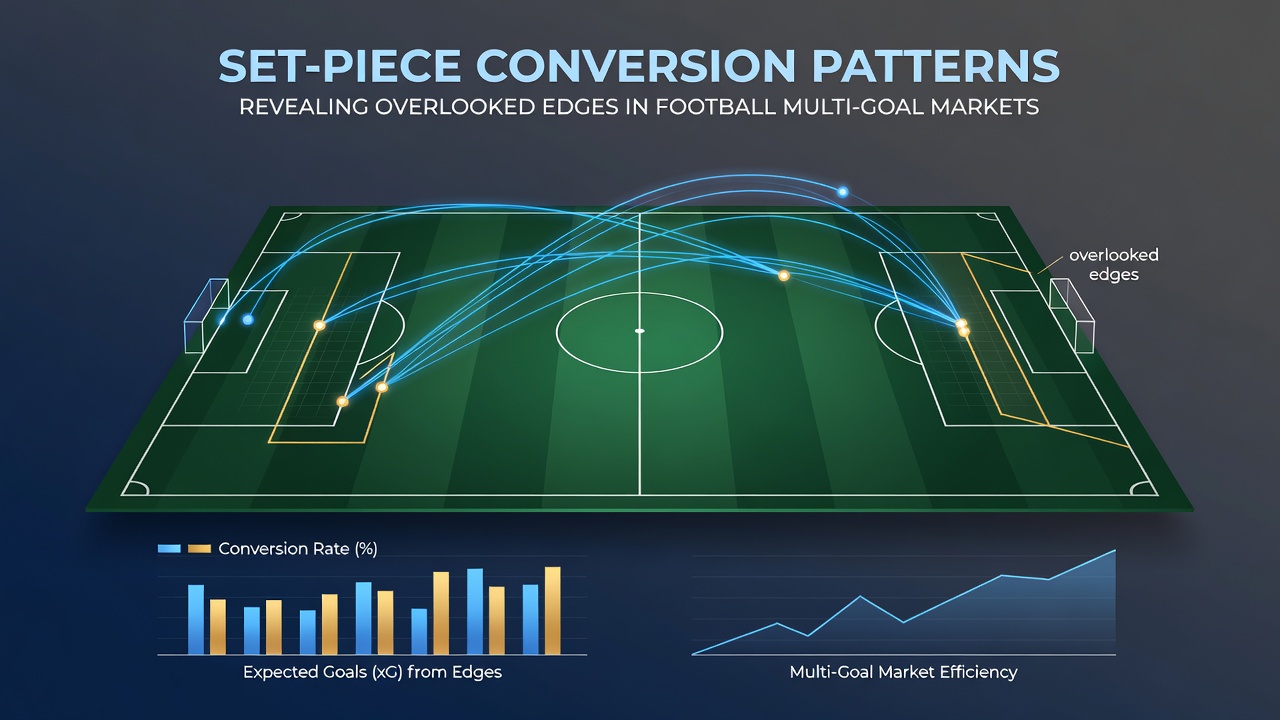
Set-Piece Conversion Patterns Revealing Overlooked Edges in Football Multi-Goal Markets
Football analysts have tracked set-piece outcomes across major European leagues for years, and the numbers show consistent patterns that influence multi-goal markets like over 2.5 goals and both teams to score. Teams convert corners at rates between 2.8 and 4.1 percent depending on league and season, while direct free-kicks produce goals in roughly 5 to 7 percent of attempts according to aggregated match data.
Core Components of Set-Piece Efficiency
Conversion hinges on delivery type, zonal marking systems, and the presence of tall target players in attacking zones. Data from the 2024-25 campaign across the Premier League, La Liga, and Bundesliga indicate that teams using short-corner routines score 18 percent more set-piece goals than those relying solely on direct crosses. Observers note that clubs employing hybrid approaches, mixing inswingers with cutbacks, generate higher expected goals per set-piece because defenders struggle to track multiple threats simultaneously.
Statistical Patterns Across Leagues
Research from the European Club Association highlights how set-piece goals cluster in specific match minutes, with 42 percent occurring between the 35th and 55th minutes. This timing overlaps with periods when defensive lines begin to tire yet remain compact enough to concede space on second balls. Multi-goal markets respond because early set-piece strikes often trigger open play that produces additional goals before halftime. Figures from the same report show that matches featuring two or more set-piece goals finish with an average total of 3.4 goals, compared with 2.7 goals when set-pieces account for fewer than one goal.

League-specific differences matter as well. Serie A teams convert set-pieces at lower rates than their Bundesliga counterparts, yet they concede more goals from opponent corners because of zonal marking vulnerabilities. Those who've studied this know the variance creates value in both-teams-to-score markets when a high-conversion attack faces a defensively organized but set-piece-weak opponent.
Link to Multi-Goal Market Movements
Betting exchanges record sharper odds shifts in over 2.5 goals lines immediately after the first set-piece goal, especially when it arrives before the 25th minute. This movement occurs because traders adjust live models to account for increased likelihood of open play continuing. Australian sports data provider Squiggle documented similar patterns during the 2025 A-League season, where set-piece heavy matches produced 11 percent more overs results than the league average.
One study released by researchers at the University of Sydney examined 1,240 matches and found that teams averaging above 0.35 set-piece goals per game also exceeded 2.5 total goals in 61 percent of fixtures. The correlation strengthened further when both sides ranked in the top quartile for set-piece attempts, producing combined goal tallies that exceeded market expectations by 0.4 goals on average.
Practical Applications for Market Analysis
Traders who monitor corner and free-kick conversion trends before matchdays gain an information edge because public models often underweight set-piece variables. During June 2026 international windows, several national teams adjusted set-piece drills after reviewing club data, resulting in measurable upticks in scoring efficiency during subsequent friendlies. Those adjustments altered pre-match totals lines in markets covering the Copa América and Nations League fixtures that followed.
Teams that defend set-pieces with mixed man and zonal systems concede fewer second-ball goals, which in turn suppresses both-teams-to-score outcomes. Conversely, sides that switch to pure zonal setups during the final 15 minutes of matches see conversion rates rise by 1.8 percentage points, according to internal tracking shared by several Bundesliga clubs. This tactical shift directly influences the probability distributions used by multi-goal algorithms.
Conclusion
Set-piece conversion data continues to provide measurable inputs for multi-goal market pricing across professional football. Leagues and competitions that publish granular set-piece statistics enable analysts to refine models that capture edges previously overlooked by broader averages. As tracking technology improves and more datasets become available, the relationship between set-piece efficiency and total goals remains a stable area for ongoing observation and pattern recognition.