Pitch Dimensions Shape Passing Efficiency in Elite Soccer Matches
Written by Casey Wolf · Aug 20, 2026

Pitch Dimensions Shape Passing Efficiency in Elite Soccer Matches
Professional soccer pitches vary in size within FIFA guidelines that set minimum and maximum lengths between 100 and 110 meters for length and 64 to 75 meters for width, yet these differences produce measurable effects on passing patterns during fixtures. Data from multiple European leagues shows that wider pitches correlate with higher completion rates for long-range passes, while narrower surfaces increase the frequency of short combinations under pressure. Analysts track metrics such as pass completion percentage, progressive passes per 90 minutes, and expected pass value to quantify these shifts across clubs that alternate between venues.
Measurement Standards and Data Collection Methods
Researchers collect pitch measurements from official stadium records and cross-reference them with Opta and Wyscout tracking systems that log every ball touch with spatial coordinates. In August 2026 several top divisions began publishing standardized pitch reports that include exact boundary markings and goal-line widths, which allows direct comparison between matches played on the same day at different grounds. Teams record player movement at 25 frames per second, then calculate average distances between teammates at the moment of each pass attempt, revealing how available space changes with overall field area.
Studies from the University of Groningen demonstrate that an increase of five meters in width raises the average pass distance by 1.8 meters while improving completion rates on switches of play by roughly three percentage points. Observers note that these patterns hold across both domestic leagues and UEFA competitions where clubs encounter varying pitch profiles within short time frames.
Comparative Analysis Across Leagues
English Premier League grounds average 105 meters by 68 meters, whereas some Bundesliga stadiums stretch closer to the maximum width of 75 meters. Figures from the 2025-26 season indicate that teams playing on the wider surfaces record 12 percent more passes into the final third per match. In contrast, La Liga venues that tend toward narrower profiles show elevated rates of passes attempted in the middle third, often exceeding 450 such actions per fixture.
One study revealed that midfielders on larger pitches complete 8.4 progressive passes per 90 minutes compared with 7.1 on smaller surfaces, although the difference narrows when teams face high-pressing opponents. Data indicates that central defenders benefit most from extra width because they gain clearer lanes for diagonal distribution, whereas full-backs experience greater variability depending on tactical instructions.
Player Positioning and Tactical Adjustments
Coaches adapt formations when traveling to venues with different dimensions, shifting from a compact 4-3-3 on narrower pitches to a more spread 3-5-2 on wider ones. Tracking data shows that average team width increases by 4.2 meters on larger fields, which stretches defensive lines and creates gaps for through balls. Pass efficiency metrics improve when midfield trios maintain distances between 12 and 15 meters, a spacing more readily achieved on broader surfaces.
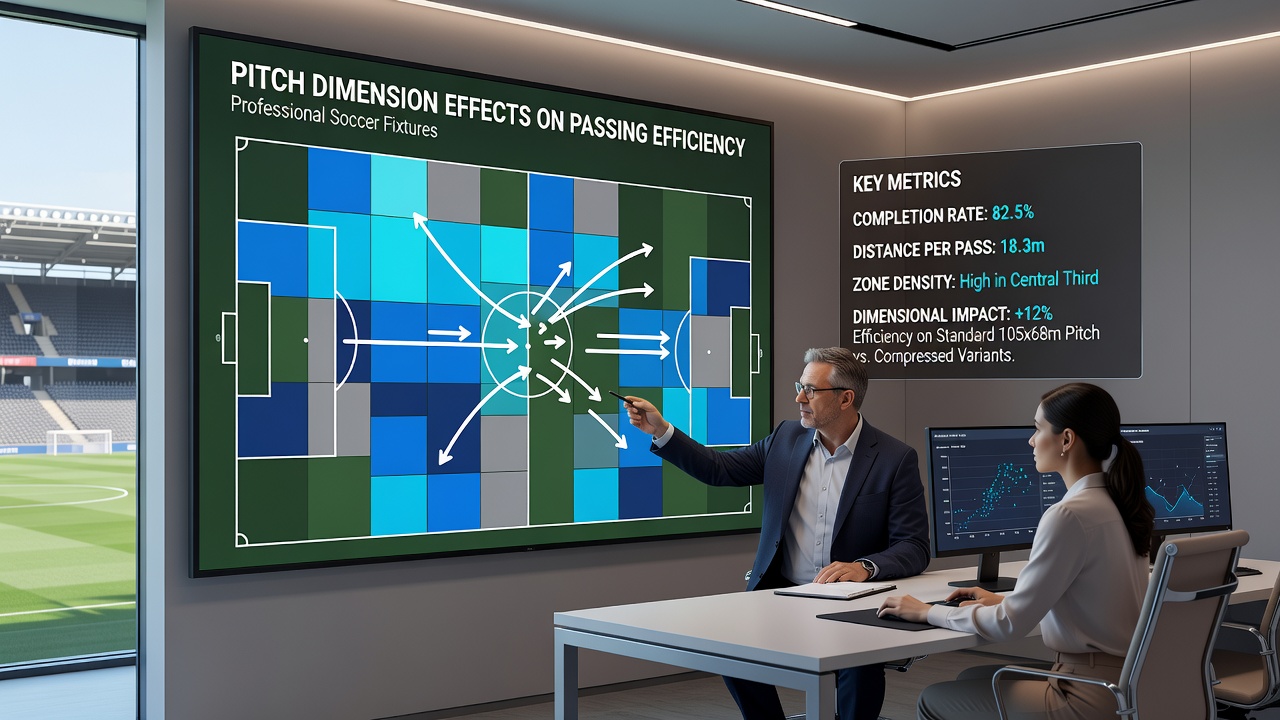
Goalkeepers also adjust distribution ranges according to pitch length, favoring longer kicks when the field exceeds 108 meters. Performance analysts at clubs competing in multiple competitions compile venue-specific heat maps that highlight zones where pass success drops below 75 percent, allowing targeted training drills before away fixtures.
Impact on Set-Piece and Transition Play
Corner delivery success rises on wider pitches because teams can create better crossing angles from deeper positions. Researchers discovered that teams attempting more than six corners per match on fields measuring 72 meters or wider convert 14 percent of those opportunities into shots on target, compared with 11 percent on narrower grounds. During transitional phases, longer pitches permit higher recovery lines without leaving space behind the defense, which in turn supports sustained possession sequences averaging 18 seconds longer than those recorded on compact surfaces.
According to reports from the European Club Association, clubs that rotate squads across fixtures with contrasting pitch sizes maintain more consistent passing networks when they rehearse spatial awareness drills that simulate both extremes. These preparations reduce the drop in efficiency that otherwise occurs during the first 15 minutes of matches played away from home.
Conclusion
Pitch dimensions continue to influence passing efficiency metrics in measurable ways across professional soccer. Organizations such as FIFA and academic institutions collect and publish data that clarifies these relationships, enabling teams to refine preparation and in-game decisions. As tracking technology advances, further granular analysis will likely emerge from matches scheduled through the remainder of 2026 and beyond.