Mapping wind pattern shifts across fairways to refine club selection forecasts in major golf tournaments
Written by Amir Simon · May 16, 2026
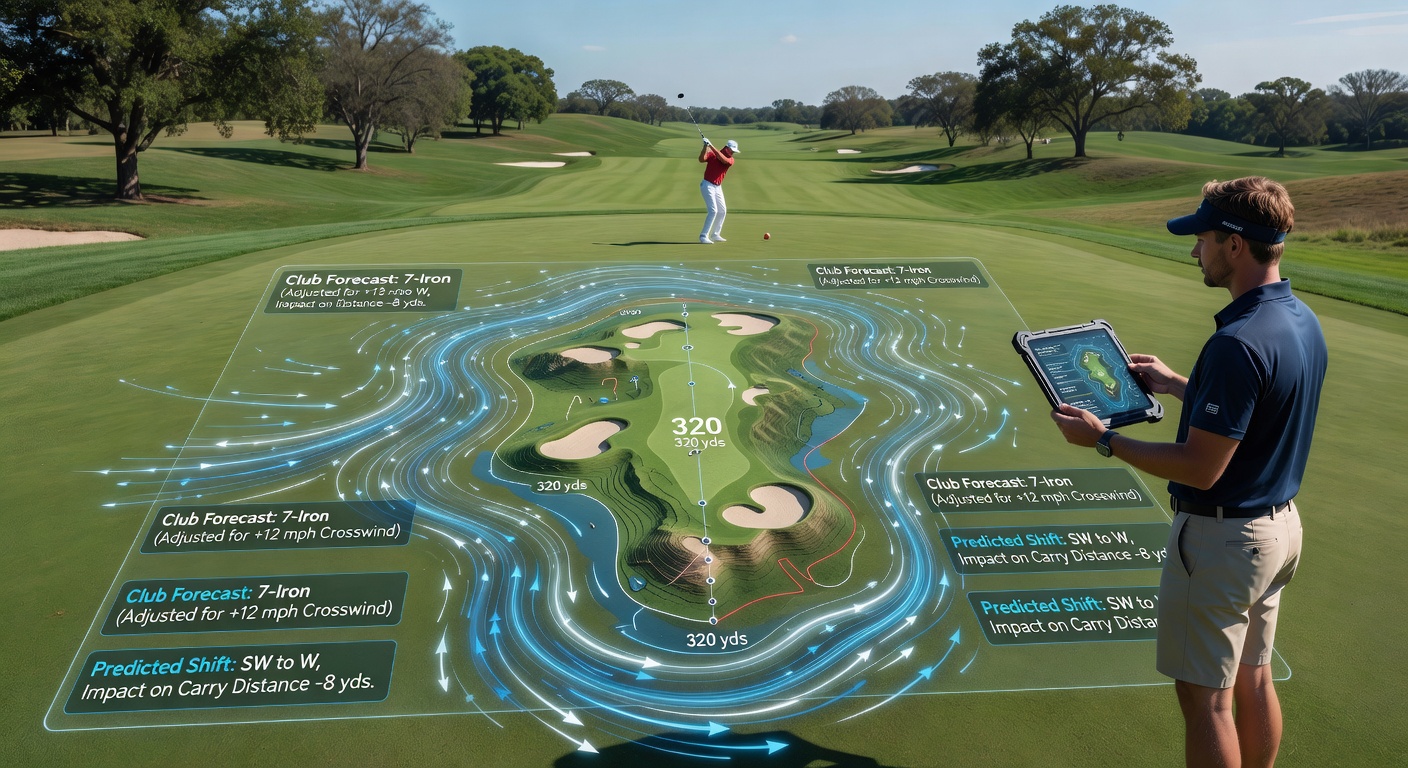
Mapping wind pattern shifts across fairways to refine club selection forecasts in major golf tournaments
Wind mapping has become a central tool for players and analysts seeking precise club selection in major golf tournaments, where small changes in breeze can alter ball flight by several yards and shift scoring averages noticeably. Meteorologists and course technicians combine real-time sensor data with historical wind records to create layered forecasts that track direction, speed, and gust patterns across each hole, and these models help golfers adjust loft and swing path before every shot.
Technology driving accurate wind forecasts
Portable anemometers placed at multiple points along fairways record wind vectors every few seconds during tournament weeks, while Doppler radar and satellite feeds supply broader atmospheric context that reveals how pressure systems move across the course layout. Data from the National Oceanic and Atmospheric Administration supplies baseline models that tournament organizers refine with on-site readings, and this combination allows forecasters to predict gust corridors that develop after midday heating or evening cooling. Researchers at institutions such as the University of Edinburgh have published findings on microclimate effects around tree lines and water hazards, showing that wind speed can increase by 15 to 25 percent in certain corridors compared with open areas.
Software platforms integrate these inputs into three-dimensional visualizations that highlight zones where crosswinds or headwinds will dominate during specific tee times. Players review updated maps each morning, and caddies often mark distances adjusted for projected wind values so that club choices align with expected carry and roll conditions. During the 2025 majors, several players credited these layered forecasts for avoiding over-clubbing on exposed par-3s where gusts reached 18 mph.
Application across major venues
Augusta National, Oakmont, and Royal Troon each present distinct wind signatures that forecasters study for months before events begin. At Augusta, prevailing spring winds tend to funnel down the valley toward Amen Corner, increasing the effective distance on the 11th and 12th holes by as much as 20 yards when gusts exceed 12 mph. Oakmont’s elevated fairways experience more turbulent airflow because of surrounding ridges, and data collected during the 2024 U.S. Open showed that afternoon wind shifts from west to northwest required players to add one club on several long par-4s. Royal Troon’s coastal location brings salt-laden breezes that change rapidly with tide cycles, prompting organizers to adjust pin placements according to hourly wind predictions.
Forecast teams now issue hourly wind-shift bulletins that detail expected changes in direction and speed, and these updates feed directly into digital caddie books used by competitors. One documented case during the 2025 PGA Championship at Quail Hollow revealed that accurate mapping of a late-afternoon thermal shift allowed several players to select 7-irons instead of 6-irons on the par-3 17th, producing better proximity to the hole when the wind dropped by 6 mph within a 40-minute window.

Data integration and player preparation
Tournament officials compile wind statistics from the previous five editions of each event and overlay them with current seasonal trends supplied by national weather agencies. The resulting probability tables indicate the likelihood of specific wind speeds at given times of day, and these percentages help players decide between conservative and aggressive club selections. Golf analytics firms convert the raw numbers into club-distance charts that account for altitude, temperature, and humidity alongside wind vectors, producing recommendations that players test during practice rounds.
During preparation for the 2026 PGA Championship scheduled for May at Congressional Country Club, organizers have already installed an expanded network of 28 wind sensors to capture finer variations across the redesigned back nine. Early simulations indicate that prevailing northwest flows could add between 8 and 14 yards to approaches on holes 14 through 17, prompting several players to begin building custom wind-adjustment tables months ahead of the event. Observers note that teams now allocate dedicated staff members to monitor sensor feeds throughout the round and relay real-time corrections via earpieces.
Future developments in 2026 and beyond
Advances in machine-learning models are expected to improve wind-shift predictions by incorporating soil moisture readings and vegetation growth patterns that influence surface friction. European golf federations have begun sharing anonymized wind datasets from regional opens with North American organizers, creating larger training sets that increase forecast accuracy across different climates. By May 2026, several major venues plan to deploy drone-mounted sensors that fly pre-round routes and transmit vertical wind profiles directly to player tablets, allowing last-minute club changes based on updated gust layers at 10-meter intervals above the turf.
These tools continue to evolve as tournament committees balance competitive integrity with player safety during high-wind periods. Data collected across recent majors demonstrates that refined wind mapping reduces scoring variance on exposed holes by measurable margins, and continued investment in sensor networks and modeling software supports ongoing refinements in club-selection strategies.
Conclusion
Wind pattern mapping has shifted from informal observation to a data-driven discipline that shapes club selection across every major tournament. Integrated sensor networks, historical records, and advanced modeling now deliver forecasts that players and caddies use to adjust distances and trajectories with greater precision. As venues prepare for the 2026 season, expanded monitoring systems and cross-regional data sharing promise further improvements in forecast reliability, giving competitors clearer guidance when conditions change rapidly across the fairways.